
Einwohner: 19,4 Millionen
Mitgliedsunion: BACOMA (Baptist Convention of Malawi)
Projekte in diesen Arbeitsbereichen:
Gefährdete Kinder
Kompetenzförderung
Humanitäre Arbeit
Gemeindeentwicklung
Gesundheitsfürsorge
"When a woman takes her place, no community remains the same."
Elizabeth Mvula speaks about the role of women in Malawi
Malawi is deeply patriarchal. Women are assigned a fixed role—traditionally by women themselves, but decisions are made by men. In such a context, it is difficult to change this way of life and thinking. Elizabeth Mvula, board member of EBMI, gives a touching and very personal account of how small changes are nevertheless possible and how she grew up understanding her role. The interview was conducted by Julia-Kathrin Raddek.
Julia-Kathrin Raddek (JKR): Elizabeth, you are a businesswoman and you run an electrical company in Malawi. How did you get into this position?
Elizabeth Mvula (EM): My husband and I built the company together. He is an engineer, and I studied secretarial work. We met in college. After we got married, we talked about starting our own business. I took care of the administrative aspects, such as registration, while he contributed his technical expertise. We have been running “Duma Electrics” for 25 years now and employ around 25 people.
JKR: What do you do besides your job?
EM: In addition to my business, I work as a certified lifestyle and leadership coach for the International Coaching Federation. We are working on establishing our own Chapter of Coaches in Malawi by the end of February. I also reach out to church organizations such as the Baptist Convention of Malawi to offer leadership coaching.
JKR: Who is your coaching meant for?
EM: My coaching is for both men and women, because both need support in their personal development. Although a lot of emphasis is placed on empowering women, men often get left behind, which creates an imbalance. I'm particularly interested in school leavers and people who already hold leadership positions but lack the right direction or approach. I help them find their own way instead of living up to the expectations of their parents or other people. We also support them in dealing with life's challenges so that they don't despair when they suffer setbacks. In this way, we break down barriers and help women in particular to stand on their own two feet and be themselves.

JKR: What helped you most in gaining self-confidence and trust in your own abilities?
EM: I had the privilege of coming from a well-off family. In my family, my sisters and I were just girls. Our parents never said, “You can't do that because you're a girl.” I never felt limited by my gender, but rather saw myself as a person capable of achieving anything. Once, when our door was broken, my father said, “Get the hammer and some nails and let's get started!” I was not limited by my gender. This helped me develop confidence in my abilities. This was unusual in our surroundings, as I discovered when I visited cousins who were surprised by my attitude and behavior.
JKR: Were your parents raised in the same way? Do you know anything about your grandparents?
EM: I grew up with my maternal grandmother. She had a different mindset than most people of her time. My grandfather, whom I never met, was a court clerk, which gave the family a more structured and educated outlook on life. My father's family came from a wealthy background. I consider myself privileged because I was exposed to many things that others did not have access to at such a young age.
JKR: Which person has had a particular impact on you?
EM: My father was the most important person for me. He worked in a labour union and encouraged me to read newspapers, listen to the news, get my things ready for the next school day, and he also prepared me for life. Unlike typical Malawian men, he was a very good cook and taught me how to cook. He taught me to appreciate important dates and milestones in life, to be present at important (family) events, and to celebrate even small successes.
JKR: What role has the Christian faith played in relation to being a woman and leadership responsibility?
EM: There are many pastors in my mother's family. We sang and prayed every day, and I knew all 300 songs in our hymn book by heart. My faith grew especially when I had serious health problems and was close to death. Since I was often the only woman in a male-dominated environment, I had to rely on my faith to know that I was there for a reason. I discovered that being a woman in the church is even more difficult than in other contexts, as I encountered people who preached one thing but acted in another way.

JKR: What are the biggest challenges facing women of all ages in Malawi or southern Africa?
EM: In our part of the world, people believe that a woman's place is in the kitchen and that she should not speak at the table when men are present. I have met many brilliant and talented women. They all stayed behind the scenes for fear of speaking out. Women who frequently spend time among men are often considered ‘immoral,’ so many marry before they are ready. Others remain in toxic marriages to maintain social respect. Women often feel they must consult men before making decisions. Change is difficult to achieve because it is often women themselves who enforce these restrictions through cultural practices. Rituals and ceremonies are performed at different ages to prepare girls for their roles. This concerns their role in society, their physical and mental changes at the onset of puberty, their sexuality, marriage and motherhood. These initiation rites begin as early as the age of eight. So a girl learns very early on what it means to be a woman.
JKR: How do you personally deal with these challenges and how are you involved in the church in this regard? Can you name a specific project that has an impact on women's daily lives?
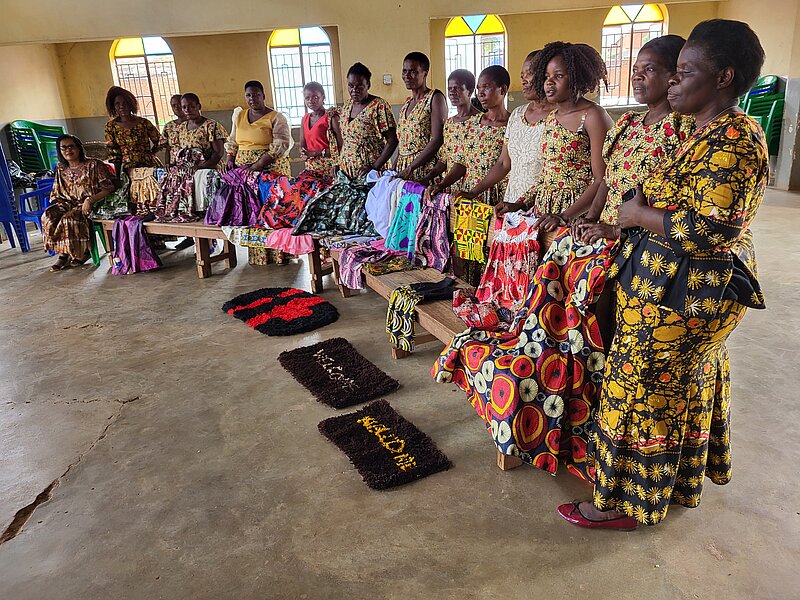
EM: I take a negotiation approach, making sure that we have the acceptance of older women and men before I take any initiatives. With the help of programmes supported by EBMI, we have empowered women to make their own decisions. Three encounters have particularly moved me: Firstly, a pastor's widow. After attending our course, she had the idea of growing her own vegetables. She had a piece of land, so she asked us for seeds, fertiliser and agricultural equipment. Three years later, she had built a house and planted a garden that fed her family. Secondly, there was the wife of a pastor who, after her husband's death, had to leave the home they had shared for 40 years. In Malawi, it is customary for the husband's family to claim ownership of the property, leaving the widow destitute. She returned and wanted to build a church in her hometown. Although our church does not ordain women, she believed that she could also be a pastor and start a congregation. A third example was women who built a house for a woman who had lost everything in floods in northern Malawi.
JKR: What is your biggest dream for Malawian women?
EM: My biggest wish for women in Malawi is that they grow beyond what they are now, that they believe they are capable of anything, and that they recognise their ability to change the world. When a woman takes her place, no community remains the same. I want them to recognise how much they are already doing and to seize their potential with both hands, because they are the key to change in their communities.
JKR: Thank you very much, Elizabeth, for this very personal insight!
Elizabeth Mvula is a long-standing member of the honorary international board of EBM INTERNATIONAL. The interview was conducted by Julia-Kathrin Raddek.
This article first appeared in EBMI Magazine 1/2026
Empowering women together
In many parts of the world, girls and women are still disadvantaged: they have poorer access to education, fewer rights, and hardly any economic opportunities. And yet they are the ones who support families, shape communities, and pass on life. In more than 40 projects around the world, we therefore train, encourage, protect, and support girls and women.